Updated 9 Nov 2026
Did you know Google says you don’t need an llms.txt file or any special schema to appear in its AI Overviews?
That surprises a lot of people, because “GEO” advice is everywhere right now. Here’s what GEO actually is, what Google and Bing say about it, the catch, and what you can do this week.
What is Generative Engine Optimization (GEO)?
Generative engine optimization (GEO) is the work of making your content easy for AI-powered answers, like Google AI Overviews and AI Mode, ChatGPT search, Perplexity and Microsoft Copilot, to find, understand and cite.
The term comes from a 2023 research paper by Aggarwal and colleagues (Princeton University, IIT Delhi and others), published at the KDD 2024 conference. You’ll also hear “AEO” (answer engine optimization) for roughly the same idea.
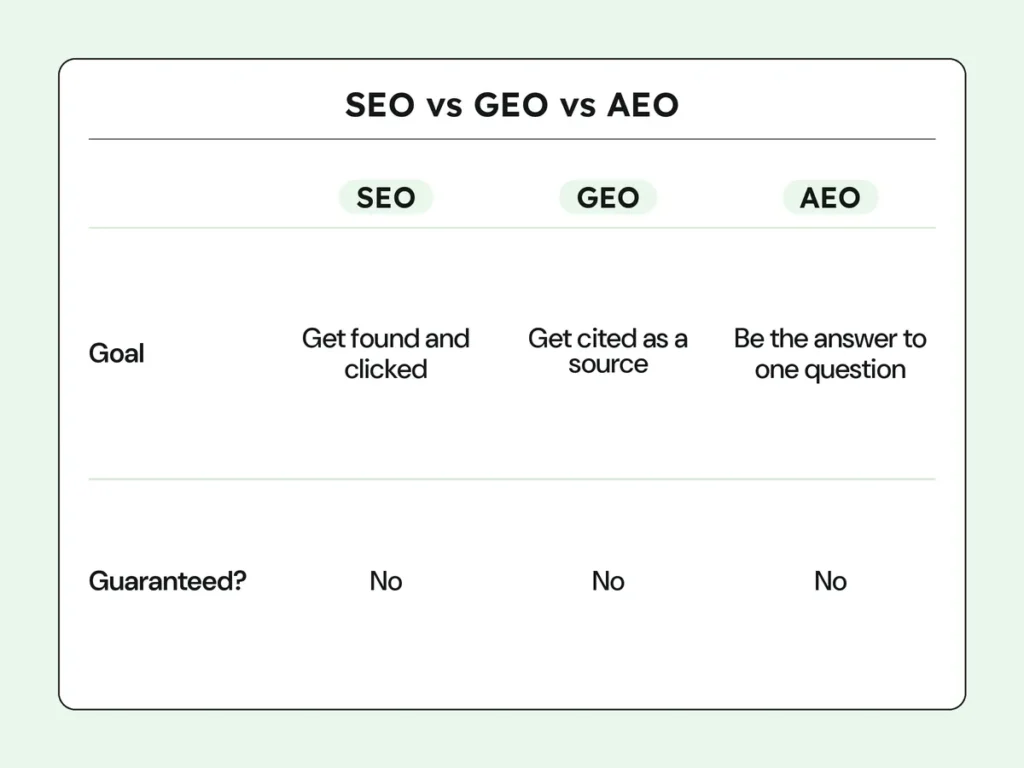
What it means for you: for Google, this isn’t a separate discipline. Google’s own guide says optimizing for its generative AI features “is optimizing for the search experience, and thus still SEO.” Bing says the same SEO fundamentals decide what Copilot can ground on and cite. See also SEO vs GEO vs AEO.
How is GEO Different from Traditional SEO?
| Classic SEO | GEO / AI answers | |
|---|---|---|
| Where you show up | Blue links in Google and Bing results | Links and citations inside AI answers (Google AI Overviews and AI Mode, Copilot, ChatGPT search, Perplexity) |
| What it needs | Crawlable, indexed pages with helpful content | The same. Google: a page must be indexed and eligible for a snippet, with no additional technical requirements |
| What helps most | Clear, original, useful pages; good structure; links | The same, plus explicit, verifiable facts and key information early (Bing) |
| How to measure | Search Console Performance report, analytics | Search Console Generative AI performance report (worldwide since 31 Aug 2026); Bing Webmaster Tools |
| Guaranteed? | No | No. Bing: “GEO does not guarantee grounding or citations” |
Why GEO matters now
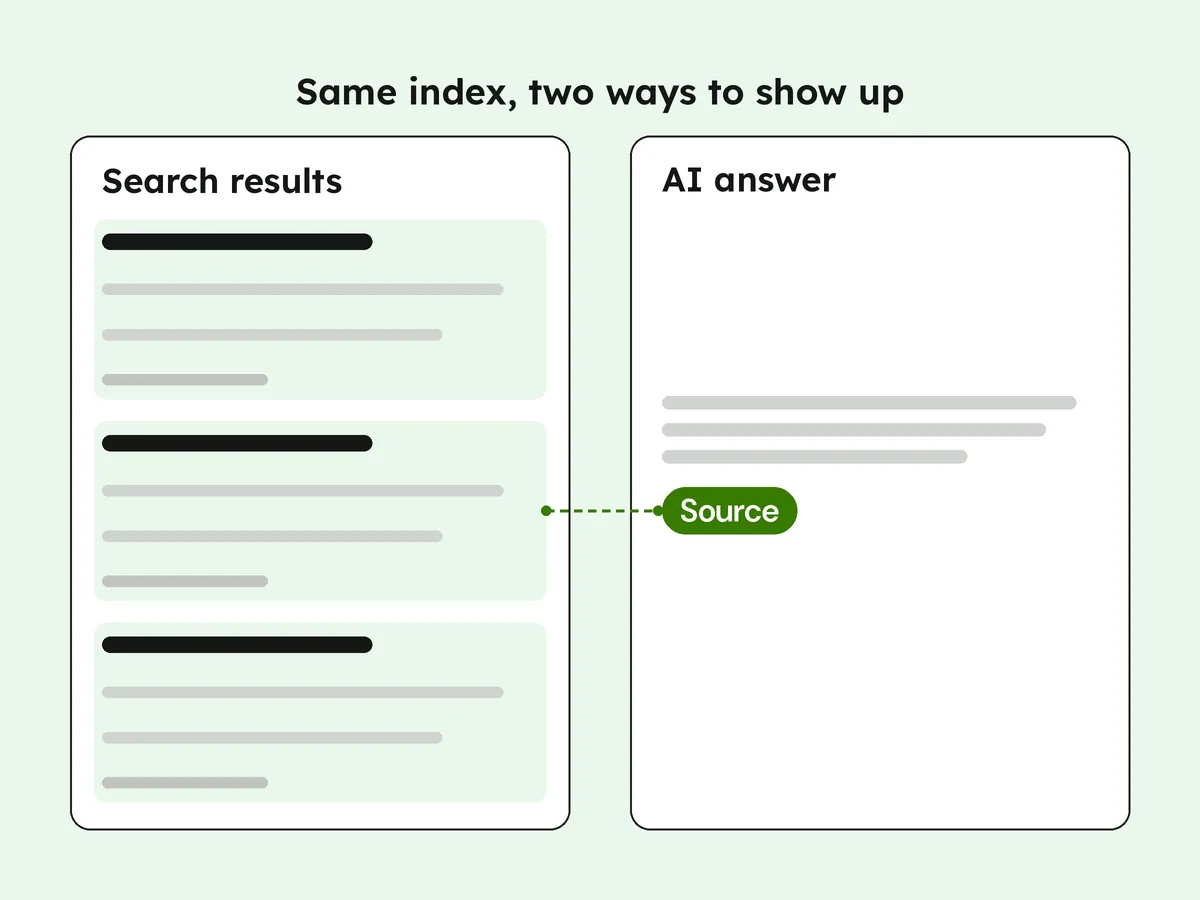
- Google Search now has AI answers built in. AI Overviews and AI Mode show links to supporting websites, and Google says these links come from its normal Search index.
- You can now measure it. Google’s Search Console has a Generative AI performance report showing how often your pages appear in AI Overviews and AI Mode. It rolled out to all sites worldwide on 31 Aug 2026.
The catch: being cited isn’t the same as getting the click, and at launch the report showed impressions, not clicks. Track enquiries and calls in your analytics too.
How to Optimize Your Website for GEO
1. Write Clear, Factual, Answer-Focused Content
AI engines look for content that directly and clearly answers questions. Use plain language, avoid jargon, and structure your content around specific questions your audience asks.
Put the answer near the top, and state facts explicitly with a source and a date. Bing’s guidelines ask for exactly this: “facts and definitions are explicit” and “surface key information early.” Google adds that unique, first-hand content, not a summary of what everyone else says, is what helps most over time.
2. Answer real customer questions (FAQs are for readers)
A short FAQ helps when it answers questions your customers really ask. Don’t add one to every page by default, and don’t expect a special result from it:
- Google limited FAQ rich results to well-known government and health websites in August 2023, then stopped showing FAQ rich results entirely on 7 May 2026 and removed the documentation on 15 Jun 2026.
- Google says there’s no special schema you need to appear in AI Overviews or AI Mode.
- FAQPage markup is still valid schema.org and does no harm, but it no longer earns anything visible in Google.
3. Use structured data that matches your page
Structured data isn’t required for AI features (Google calls overfocusing on it a myth), but it still helps search engines understand your page. Use Organization or Person, Article and Service markup where they fit, and make sure everything in the markup is also visible on the page. Both Google and Bing say markup must match the visible content.
4. Earn real mentions, don’t manufacture them
Get mentioned where your customers already look: real partners, event pages, local directories, genuine press. Skip paid link schemes and fake “mentions”. Google says seeking inauthentic mentions isn’t as helpful as it might seem, and Bing treats link buying and artificial promotion as abuse.
5. Maintain Consistent NAP (Name, Address, Phone)
For local businesses, consistent business information across all platforms (Google Business Profile, LinkedIn, website) helps AI engines confidently recommend you for local searches.
Bing’s guidelines ask for “clear and consistent naming for people, organizations, products, and locations.” Use the same business name, address and phone on your website, Google Business Profile and social profiles.
What you can skip (for Google): llms.txt files, “chunking” your content into tiny pieces, rewriting everything “for AI”, and chasing fake mentions. Google lists these among the things you can ignore for Google Search. Other tools may still read llms.txt; it neither helps nor hurts in Google.
GEO for local businesses in Dubai
If you run a local business, the basics matter more than any GEO trick: an indexable website, an up-to-date Google Business Profile, and the same name, address and phone everywhere. Google says its AI answers can include local business information, and that Business Profile and Merchant Center data help.
I’m Shahid B A, a digital marketing specialist in Dubai. I help businesses across the UAE get their sites ready for Google, Bing and AI answers. I can’t promise you’ll be cited (nobody honestly can), but I can make sure nothing on your site is stopping it. See my SEO, GEO and AI search service or read about me.
The catch
GEO can’t guarantee citations. Bing’s guidelines say it directly, and Google says that even a page that meets every requirement isn’t guaranteed to be crawled, indexed or shown. Research results also don’t transfer neatly: the original GEO paper found that adding citations, quotations and statistics raised a source’s visibility by up to 40%, but in a lab benchmark of 10,000 queries, not on your website. Treat any “GEO score” or guaranteed timeline with suspicion.
Frequently Asked Questions About GEO
Is GEO replacing SEO?
No. Google treats optimizing for its AI features as SEO, and Bing says SEO fundamentals also decide what Copilot can cite. GEO is a new name for doing SEO well, with extra attention to clear, verifiable answers.
How long does GEO take to show results?
There’s no reliable timeline. Google says recrawling a changed page “can take anywhere from several days to several months,” and appearing in AI answers isn’t guaranteed even then. Measure in Search Console’s Generative AI performance report rather than guessing.
Can small businesses benefit from GEO?
Yes, if they have something original to say. Google’s guide says unique, first-hand content is what helps most, and a small business often knows its customers better than a big one. In the original GEO study, lower-ranked pages gained the most from clearer, better-sourced writing, but that was a research benchmark, not a promise.
Want me to check what’s stopping your site from showing up in Google and AI answers? Book a free 20-minute strategy call, email info@shahidba.com or WhatsApp +971 50 685 3303.
Related: SEO vs GEO vs AEO: what’s the difference? · Services · About me
Sources
Checked 9 Nov 2026.
- Google Search Central, Optimizing your website for generative AI features on Google Search, updated 10 Jul 2026
- Google Search Central, AI features and your website, updated 10 Dec 2025
- Google Search Central Blog, Changes to HowTo and FAQ rich results, 8 Aug 2023
- Google Search Central, Documentation updates (FAQ rich results deprecated 7 May 2026, docs removed 15 Jun 2026)
- Google Search Central Blog, Introducing Search Generative AI performance reports in Search Console, 3 Jun 2026 (worldwide 31 Aug 2026)
- Bing Webmaster Guidelines
- Aggarwal et al., GEO: Generative Engine Optimization, KDD 2024